Diocese of Hereford Multi-Academy Trust
Our Family of Academies

Our Family of Academies
St. George'sCE Academy
Writing
Our Vision:
“We are here to bring learning to life for every member of our school community, just as water brings life to the world. We are here to prepare children for their journey through life as responsible respectful citizens of the future who are ambitious, courageous and kind. We are a school that is proud to be creative, caring, nurturing and challenging in equal measure. We aim to develop life-long learners who thrive in our care and bring life to the future of our world.”
And so, our vision for English is for children to see themselves as writers, creating writers who write for purpose with their audience in mind, finding enjoyment through their creativity. We aim to expose children to a wealth of literature, authors and text types to create writers who write for both pleasure and purpose.
The Teaching of Phonics and Early Writing
Phonics (spelling and reading)
At St. George’s, we believe that all our children can become fluent writers (and readers). This is why we teach reading through Little Wandle Letters and Sounds Revised, which is a systematic and synthetic phonics programme. We start teaching phonics in Nursery/Reception and follow the Little Wandle Letters and Sounds Revised progression which ensures children build on their growing knowledge of the alphabetic code, mastering phonics to read and spell as they move through school.
As a result, all our children are able to tackle any unfamiliar words as they read. At St. George’s, we also model the application of the alphabetic code through phonics in shared writing (and reading), both inside and outside of the phonics lesson and across the curriculum. We have a strong focus on language development for our children because we know that speaking and listening are crucial skills for writing and reading in all subjects.
Emergent writing
In EYFS we encourage children to write for many different purposes. There are many different stages a child needs to explore when learning to write. The very first stage may be a child just making marks on a piece of paper. As your child develops their knowledge of early writing skills and control of simple drawing tools, they will begin to write some letter shapes. Praise and encouragement are vital.
The teaching of early writing is prioritised, every opportunity is used to promote writing. The classroom is rich in vocabulary, prompts for writing and a wide range of materials and tools are available for children to use to mark make and write.
Children’s imitation story maps. The Class Story map of Handa’s Surprise. Role play with Handa’s Surprise. Class 3’s persuasive writing.


Why Talk for Writing?
At St George's CE Academy, we want all our children to develop into thoughtful readers and creative writers and it is through the Talk for Writing approach that we believe we can achieve this. Through its multi-sensory and interactive teaching, it enables children of all ages and abilities to learn to write a wide range of story/text types using various methods including:
- listening to and learning texts and stories;
- taking part in drama and role-play;
- drawing and story mapping;
- collecting words and language strategies
- building their working knowledge of grammar.
What is the process?
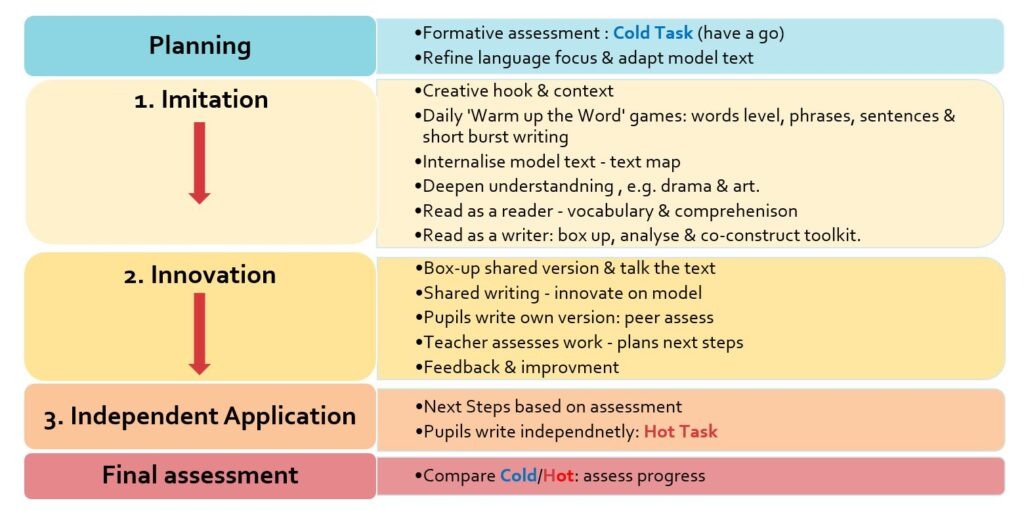
Talk for Writing has three key phases that work together to develop knowledge, confidence and independence in writing:
Imitation and immersion
We usually like to start our Talk for Writing work with short burst poetry which fires up the creativity and imagination of the children before they immerse themselves in the model text.
During this phase the children learn a model text using actions and story maps. The key to success for this is that they internalise the text type through repetition and rehearsal. They explore the structure of the narrative and investigate the different characters, settings and events. They also begin to look closely at the language used and the effect this has on the reader. We call this process ‘read as a writer’. The classroom becomes a dynamic, interactive resource filled with word ideas, sentence types and language tools collected by the children to use in their stories later.
Innovation
During this phase the teacher and the children begin to change aspects of the model text using their own ideas.
They explore the text using different characters, settings or events and new ideas for descriptive language whilst hugging closely to the underlying structure.
It is during this phase that the children work using their toolkits. The toolkits, based on the features and ingredients of the model text, remind children of the different strategies they could use in their stories and helps them to see the progress they are making.
Invention
During the invention week the children plan and write their own story based on the text type they have been learning. They experiment with the ideas and begin to explore their own style of writing using sentence types from the model text.
Spelling
At St George's CE Academy, once the children have completed the Little Wandle phonics scheme, we use Spelling Shed to support the teaching of spelling.
Each child is given an individual login where they can access Spelling Shed online and practise their spellings at home.
Writing Genres
Writing Genres planned and sequenced over a 2-year cycle to ensure that children develop a bank of text types. The Fiction, Non-Fiction and Poetry genres have links to the curriculum theme.


Valuing Writing:
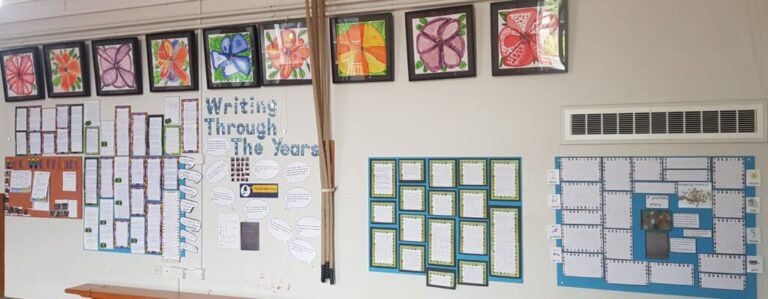
Writing through the years: every child’s writing displayed in our hall.
Children’s writing is valued. Children’s writing is shared and displayed in school: in classroom displays; on the Star of the week display board, our on whole school writing display and through our Friday sharing assembly. In our community: on the school newsletter; class pages on our school website and in the Clun Chronicle publication. To a global audience through online blogging, such as, TeachingLive.net and our website.
Handwriting
A flexible, fluent and legible handwriting style empowers children to write with confidence and creativity. Handwriting is a developmental process with its own distinctive stages of sequential growth.
There are five stages that form the basic organisational structure of the Penpals Handwriting Scheme which the school follows:
- Physical preparation for handwriting: gross and fine motor skills leading to mark-making, patterns and letter formation (EYFS)
- Securing correct letter formation (Key Stage 1, Year 1)
- Beginning to join along with a focus on relative size and spacing (Key Stage 1, Year 2)
- Securing the joins along with a focus on break letters, legibility, consistency and quality (Lower Key Stage 2,)
- Practising speed, fluency and developing a personalised style for different purposes (Upper Key Stage 2)
Handwriting must also be practised discretely and in context. Handwriting is best taught through frequent, discrete lessons with ‘little and often’ follow up. This is timetabled as a 20 minute weekly lesson (10mins whole class, 10 independent practise), 5 minute daily practice (school/home) and monitored across the curriculum.
Grammar
Year group Grammar objectives are taught both discreetly and used and applied in context. SPAG.com is used in KS2, as homework and as an assessment tool. Focused grammar objectives are sequenced across the year. Year by Year progression is grammar is detailed in appendix 1.
Assessment
Teachers’ assess writing against the Early Learning goals (EYFS) and National Curriculum Objectives. Each unit starts with a ‘Cold Task’, formative assessment allows the teacher to plan for the learning needs of the class, specific groups and individual children. The unit ends with a ‘Hot Task’ to allow progress to be measured and inform future planning.
St. George'sCE Academy
Contact Us
St. George's CE Academy, School Road, Clun, Craven Arms, Shropshire, SY7 8JQ