Diocese of Hereford Multi-Academy Trust
Our Family of Academies

Our Family of Academies
St. George'sCE Academy
RE
|
St George's is clear about its mission. We are here to bring learning to life for every member of our school community, just as water brings life to the world. We are here to prepare children for their journey through life as responsible respectful citizens of the future who are ambitious, courageous and kind. We are a school that is proud to be creative, caring, nurturing and challenging in equal measure. We aim to develop life-long learners who thrive in our care and bring life to the future of our world. Our core values are kindness, courage and ambition. Like the flow of water in a river, they flow through our vision and in everything we do for our children to be the life-giving future of our world. We learn about our values during worship, class time, playtime and with our friends, teachers and families.
Religious Education is central to the purpose of St George’s because as a church school, we see that the Christian faith informs all aspects of our life, locally, nationally and through global contexts. We create learning opportunities in Religious Education that will inspire, enthuse and motivate children in their exploration of religions. Religious Education supports and strengthens our Christian vision, ethos and values which are at the heart of what we aim to do in every aspect of school life. The importance of the whole child, spiritually, morally, culturally and intellectually is reflected in our RE curriculum. What do we intend? Aims in Religious Education As a Church School, we aim to help children explore the spiritual dimensions of life and lay the foundations for understanding the Christian faith. Religious Education helps to provide a unique contribution within a ‘broad and balanced curriculum’ to ensure our children are prepared well to live life in modern Britain. We aim for all our children to flourish and thrive as individuals, developing dignity and respect, encouraging all to live well together. The foundation of RE in St George’s is the study of Christianity as a living and diverse faith, focused on the teaching of Jesus and the Church. Whilst this underpins our studies, we have “a deep respect for the integrity of other religious traditions and worldviews and the religious freedom of each person” (Deeply Christian, Serving the Common Good). With this in mind, our syllabus is based on the Herefordshire Agreed Syllabus for Religious Education (2025-2030) and is structured around key questions, the exploration of which encourages pupils to develop and use their skills of reflection, interpretation, analysis and application, as well as developing their knowledge and understanding of religion and worldviews. The syllabus asserts the importance and value of Religious Education for all pupils, with on-going benefits for an open, articulate and understanding society. It states that the principal aim of RE is: “To explore what people believe and what difference this makes to how they live, so that pupils can gain the knowledge, understanding and skills needed to handle questions raised by religion and worldviews, reflecting on their own ideas and ways of living” At St George’s, we aim to enable all pupils to:
Using the Herefordshire Agreed Syllabus The DHMAT adopted the 2025 Herefordshire Agreed Syllabus. This syllabus is designed to support schools in delivering excellence in RE. It responds to national calls for deepening pupils’ knowledge about religions and for developing their “religious literacy”. It does this by studying one religion at a time (systematic units) and then includes thematic units which build on learning by comparing the religions, beliefs and practice studied. The teaching and learning approach has three core elements which set the context for open exploration of religion and worldviews: Making Sense of Beliefs, Understanding the Impact and Making Connections. The syllabus also reflects ways of knowing disciplines, theological, philosophical and human and social sciences. How will we implement it? Our curriculum Our curriculum is based on the Herefordshire Syllabus. It sets out an underlying teaching and learning approach where the three core elements are woven together to provide breath and balance within teaching and learning about religions and worldviews. These elements set the context for open exploration and offer a structure through which pupils can encounter diverse religious traditions alongside non-religious world views. Our curriculum is based around a key question approach. These key questions are also based on the core elements and have been carefully sequenced to support pupils develop key skills and knowledge, building on what has been learnt before and preparing for what is to come. Our curriculum has been structured to make sense to pupils, focus on core concepts, allow pupils to encounter diverse examples of religion and worldviews, enable pupils to embed learning, allow for pupils’ personal worldviews, encourage pupils’ personal development and allow pupils to make connections between ideas, the world around them and their own worldviews.
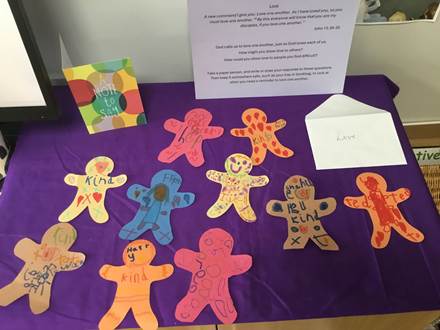
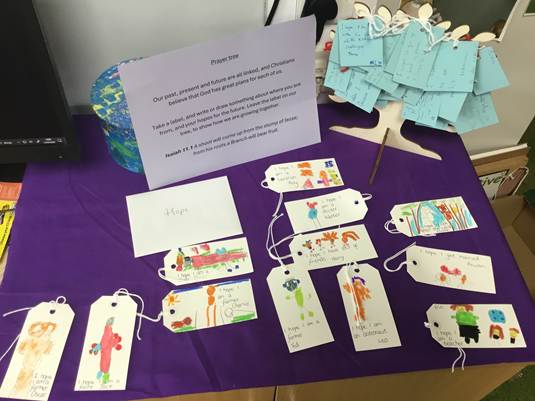
EYFS- The Agreed Syllabus for RE sets out experiences, opportunities and appropriate topics for children in the Foundation Stage which connect to the seven areas of learning. RE sits very firmly within the areas of Personal, Social and Emotional Development and Understanding the World. The framework enables children to develop a positive sense of themselves, others and how to form positive and respectful relationships. They will do this through a balance of guided, planned teaching and pursuing their own learning within the enabling environment. They will begin to understand and value the differences of individuals and groups within their own immediate community. Children will have the opportunity to develop their emerging moral and cultural awareness. In Reception, children will encounter Christianity and other religious and non-religious worldviews, as part of their growing sense of self, their community and their place within it. Key Stage One and Two- The Agreed Syllabus requires that all pupils develop an understanding of Christianity in each Key Stage. The three elements of teaching and learning also incorporate the teaching resource Understanding Christianity. In addition, across the age range, pupils will develop an understanding of the principal religions and non-religious worldviews represented in the UK. In Key Stage 1, pupils study the religious traditions of Christians, Jews and Muslims. In Key Stage 2, pupils study the religious traditions of Christians, Muslims, Hindus, Jews and non-religious worldviews (for example Humanists). As a church school, we provide an increased amount of time devoted to the teaching of Christianity. Teaching and learning in RE At St George’s, RE is generally taught on a weekly basis, but occasional enrichment days to support Christian festivals such as harvest and Easter offer more teaching time. Our scheme of work for RE maintains a balance between the three core elements of Making Sense, Understanding the Impact and Making Connections. Units are based on the key questions and also identify tools/methods/ways of knowing that pupils can use to find out information and create knowledge. The scheme of work ensures that there is continuity and progression for pupils and opportunities for assessment, with clear unit outcomes. We employ a variety of teaching methods to ensure Religious Education is a lively, active subject. These include discussions, recording, drama, art, music, the use of artefacts, stories, visits and periods of stillness and reflection. We include activities that challenge pupils, promote independent enquiry, promote creative thinking, enable collaboration and enable opportunities for pupils to organise and reflect upon their own learning. Our teaching enables children to extend their own sense of values and promotes their spiritual growth and development. We encourage children to think about their own views and values and enable children to build on their own experiences. Where possible, we want our pupils to have opportunities to encounter local faith communities through visits to places of worship or visits from members of religious and non-religious communities. How will we know it is working? Assessment is related to End of Phase Outcomes and expectations, which focus on knowledge, understanding and skills. Within each unit of work, learning outcomes are presented that relate to the End of Phase Outcomes. These unit learning outcomes are specifically related to the knowledge and skills required to address key questions and relate to the three elements of the teaching and learning approach-Making Sense of Beliefs, Understanding the Impact and Making Connections. The spiral nature of the curriculum means that pupils will encounter some of the same concepts in different questions at different stages. Exploring the same concepts again, from a different perspective and using different materials is essential to support pupils’ ability to connect ideas and develop a coherent understanding of religion and belief, consolidating and embedding learning. During Religious Education lessons, learning intentions are shared with the children and pupils are encouraged to develop skills to enable them to self-assess their own progress and to understand how to improve their work in RE. Throughout the unit, teachers should be aware of how far pupils achieve the outcomes, so as to guide their next steps in teaching and learning. Each teacher is responsible for regular assessment, through questioning, observation and marking. RE will be assessed against the end of phase outcomes in order to make an overall judgement as to whether children are: working towards, at expected, at greater depth. There are numerous ways in which our children demonstrate that our RE curriculum is effective, for example the quality of responses in RE books, their verbal responses, photos, their reflections, their use of quality questions, the ability to make links/connections and through pupil voice. FOR FURTHER INFORMATION, PLEASE SEE THE RE POLICY |
St. George'sCE Academy
Contact Us
St. George's CE Academy, School Road, Clun, Craven Arms, Shropshire, SY7 8JQ