Diocese of Hereford Multi-Academy Trust
Our Family of Academies

Our Family of Academies
St. George'sCE Academy
Oracy
The Oracy Education Commission defines oracy as
“Articulating ideas, developing understanding and engaging with others through speaking, listening and communication.”
Oracy education is therefore the intentional cultivation of the ability to articulate ideas, develop understanding and engage with others through speaking, listening and communication. It comprises three interrelated, overlapping and mutually reinforcing components:
- Learning to talk, listen and communicate: the development of children’s speaking, listening and communication skills.
- Learning through talk, listening and communication: the use of talk or dialogue to foster and deepen children’s learning.
- Learning about talk, listening and communication: building knowledge and understanding of speaking, listening and communication in its many contexts
In addition, we also value the power of oracy education in increasing the confidence and wellbeing of our pupils, empowering them with the belief that their voice has a value and developing the ability to articulate thoughts that others will listen and respond to.
The Oracy Skills Framework specifies the various skills young people need to develop to deal with a range of different talk situations. At St George's CE Academy, we have developed our oracy curriculum with these components in mind.
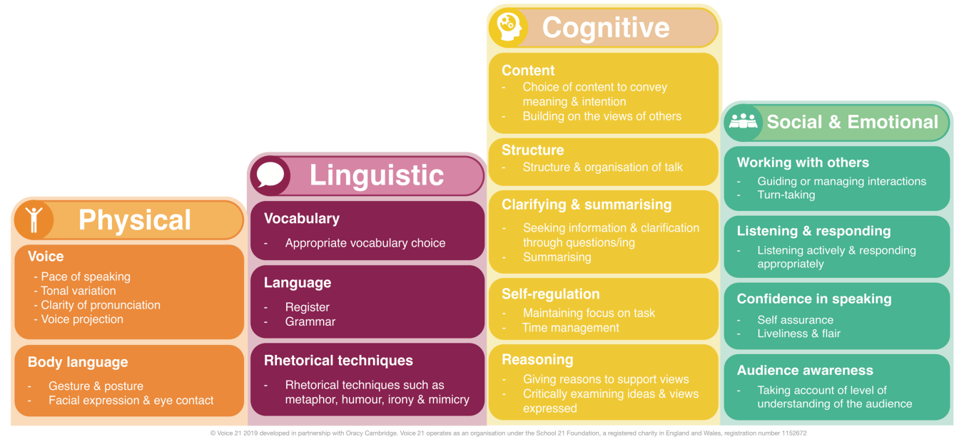
This is how it works:We use a variety of teaching and learning approaches to teach oracy skills across the curriculum, including:
|
St. George'sCE Academy
Contact Us
St. George's CE Academy, School Road, Clun, Craven Arms, Shropshire, SY7 8JQ