Diocese of Hereford Multi-Academy Trust
Our Family of Academies

Our Family of Academies
St. George'sCE Academy

Maths
Our Vision:
“We are here to bring learning to life for every member of our school community, just as water brings life to the world. We are here to prepare children for their journey through life as responsible respectful citizens of the future who are ambitious, courageous and kind. We are a school that is proud to be creative, caring, nurturing and challenging in equal measure. We aim to develop life-long learners who thrive in our care and bring life to the future of our world.”
And so, our vision for Maths is to for children to see themselves as mathematicians. We promote a ‘can do’ attitude to maths without a fear of making mistakes to produce individuals who are numerate, creative, independent, inquisitive, enquiring and confident. We aim to develop happy and confident mathematicians, throughout their learning and into their adult life.
Early Maths
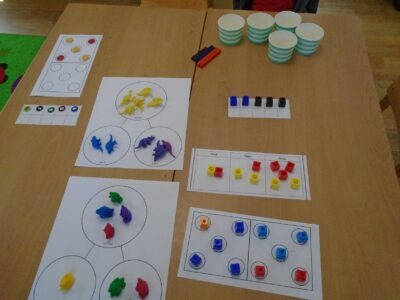
In Early Maths, we aim for all children to develop a firm mathematical foundation. There is a focus on developing mathematical language to reason and discuss, developing mathematical thinking and fluency through making connections and using manipulatives and representations to develop understanding. There is a dedicated time for children to learn mathematics and opportunities for children to apply/practise mathematical skills within the continuous provision. Early maths teaching builds on what children already know and is based on the six NCETM key concepts-cardinality and counting, comparison, composition, pattern, shape and space, measures. Our daily maths sessions are based on the national Mastering Number programme, which focuses on developing a strong number sense. This programme purposefully focuses on small numbers so that children are confident number experts and develop a deep understanding of number. Sessions includes lots of opportunities for the children to use maths talk, reason, explain their thinking, visualise number patterns, count, subitise, explore composition and comparison. There are also planned activities for the children to explore other aspects of early maths including shape, space, pattern and measures.
The Teaching of Maths
5 main ideas underpin the teaching of maths at St. George’s.
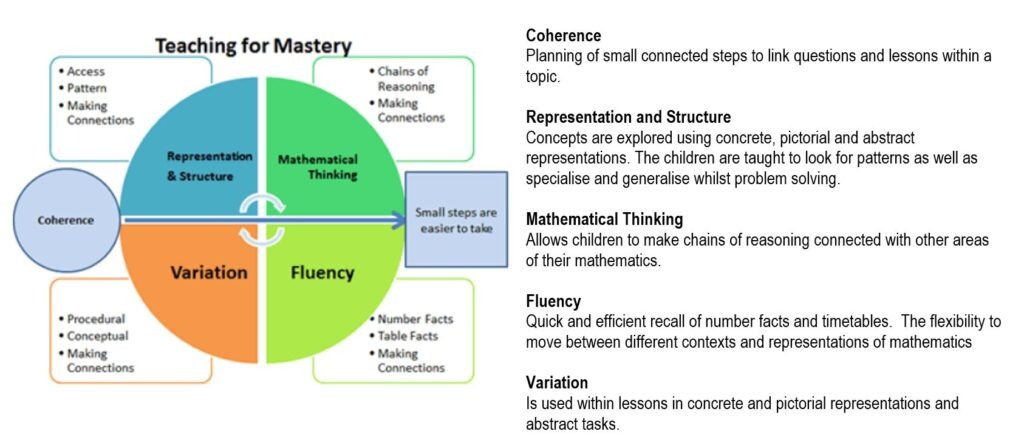
Using these 5 main ideas, we follow the White Rose block units and small steps for learning. There is a focus on fluency with each lesson beginning with a short ‘Toolbox’ session. This enables children to practise and apply number facts and timetables knowledge in a range of contexts and/or mixed concepts.
Concrete, Pictoral & Abstract
Lessons are taught using the Concrete, Pictoral & Abstract (CPA) approach.
Concrete representation
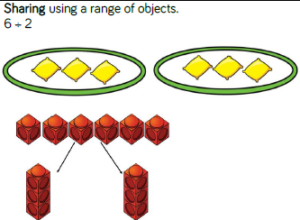 The children are first introduced to an idea or a skill by acting it out with real objects. In division, for example, this might be done by separating apples into groups of red ones and green ones or by sharing 12 biscuits amongst 6 children. This is a ‘hands on’ approach using real objects and it is the basis for conceptual understanding.
Pictorial representation
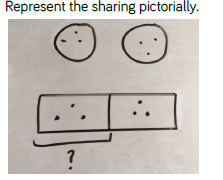 This is used when a child has sufficiently understood the hands-on experiences performed and can now relate them to representations, such as a diagram or picture of the problem. In the case of a division exercise this could be the action of circling objects.
Abstract representation
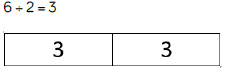 The symbolic stage – a child is now capable of representing problems by using mathematical notation, for example: 12 ÷ 6 = 2. As understanding develops, children move on to use some form of abstract representation. This could be giving values to rectangular bars (bar model) to identify what is known and what is unknown, using a symbol to stand for a number or something else.
CPA are not stages gone through once, but a continuum. There will be occasions when a child will use concrete, pictorial and abstract representations all in one session. A child who uses abstract representations in one area may need concrete representations in another. On a different occasion, a child may need to revisit a concrete representation before moving on to a pictorial or abstract one. Therefore, it is important that a variety of representations are available for children to use at all times. Our calculation policy demonstrates the progression of objectives through CPA representations.
The maths learning environment Each classroom has a maths area which is equipped with accessible resources. The children have free access to the manipulatives and are encourage to use these to scaffold their thinking and understanding. Prompts and stem sentences support the current learning and key scaffolded sentence starters are displayed. These are modelled by staff and support children with their maths talk, giving pupils the confidence to communicate their mathematical thinking and ideas.
|
|
|
|
|
|
|
Fluency, reasoning and problem solving underpins the deepening of understanding.
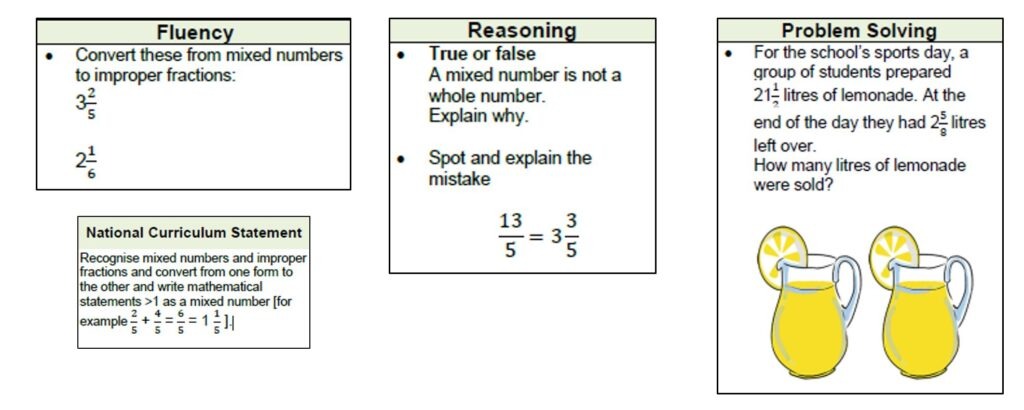
Strategies to develop pupils’ reasoning skills:
- Spot the mistake / Which is correct?
- True or false?
- What comes next?
- Do, then explain
- Make up an example / Write more statements / Create a question / Another and another
- Possible answers / Other possibilities
- What do you notice?
- Continue the pattern
- Missing numbers / Missing symbols / Missing information/Connected calculations
- Working backwards / Use the inverse / Undoing / Unpicking
- Hard and easy questions
- What else do you know? / Use a fact
- Fact families
- Convince me / Prove it / Generalising / Explain thinking
- Make an estimate / Size of an answer
- Always, sometimes, never
- Making links / Application
- Can you find?
- What’s the same, what’s different?
- Odd one out
- Complete the pattern / Continue the pattern
- Another and another
- Ordering
- Testing conditions
- The answer is…
- Visualising
Mastering Number
Throughout school, we use Mastering Number. This programme was designed to ensure that pupils develop a fluency with number that is crucial to their future success in maths
Reception/Key Stage One
It is vital to secure firm foundations in the development of good number sense for all children from Reception through to Year 1 and Year 2. The aim is that children will leave KS1 with fluency in calculation and a confidence and flexibility with number. Connections are threaded throughout the programme and questioning and repetition ensure key knowledge and skills are embedded. There is a clear progression through Reception to Year 2:
- the use of small steps in learning
- how it supports pupils to understand the relationships between numbers – to develop their ‘number sense’
- the focus on subitising and how numbers are composed
- the use of precise mathematical language
- the careful choice of representations, including the rekenrek, to expose the structure of numbers
Key Stage 2
In Key Stage 2 the programme builds upon the knowledge developed from Mastering Number KS1. It enables pupils to develop a fluency with multiplication and division facts and a confidence and flexibility with number that exemplifies good number sense.
- The representations that the children encounter (Hungarian pattern, rekenrek etc) are familiar from previous learning
- Sessions are designed to give the children the opportunity to see the mathematics so they can grow and develop their confidence
- The learning is segmented into small steps with retrieval opportunities and examples to demonstrate structure
- Questions are used to prompt children to generalise rules for themselves and the teacher questioning creates opportunities for learners to reason and think deeply throughout the session
- Children use gestures, actions and stem sentences
- It moves away from a reliance on step counting and there is the expectation to have an automatic recall of times table facts
- It makes links between multiplication and division
Assessment
Teachers’ assess maths against the NCETM progression charts and Development Matters for EYFS, the Early Learning Goals at the end of Reception and the National Curriculum Objectives. The tracking system INSIGHT is used to measure/record attainment, track objectives and identify next steps. Year 1 – 6 take part in termly PUMA or SATs assessments and to assess progress within a number or calculation unit, there are hot tasks. The hot task is towards the end of the block and assesses the taught objectives. There is time after the hot task to address any misconceptions or extend children’s learning before moving to the next unit.
Pre teaching or specific targeted interventions are sometimes used to support children who are not on track to meet age expected levels of attainment or to reach their own specific progress measures such as greater depth. These can be in the form of a precision 1:1 maths intervention such as ‘Power of Two, Number Sense or through booster maths sessions using the NCETM ready to progress materials.
More information about how we teach Maths at St. George’s.
St. George'sCE Academy
Contact Us
St. George's CE Academy, School Road, Clun, Craven Arms, Shropshire, SY7 8JQ